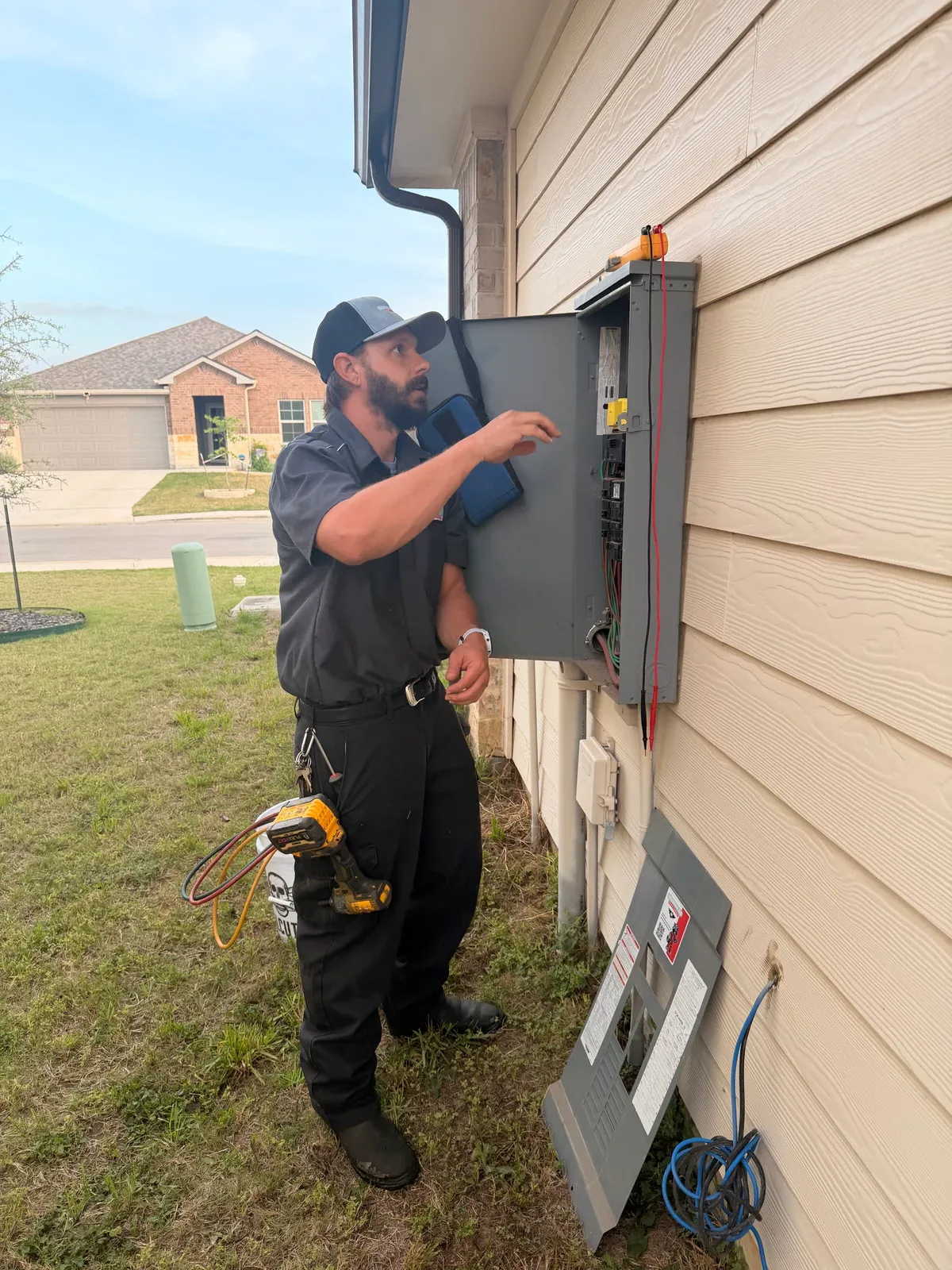
You likely need an electrical panel upgrade if your panel is a Federal Pacific or Zinsco brand, if breakers trip regularly, if you have a 100-amp or smaller service and want to add a major load like an EV charger or a second AC, if you rely on power strips because you have run out of circuits, or if the panel is 40-plus years old or shows heat damage. In older New Braunfels and Seguin homes an undersized or outdated panel is common, and it is sometimes a capacity problem and sometimes a safety one.
Your electrical panel is the heart of the whole system: it takes the power coming into the house and splits it into the circuits that feed every room, with a breaker on each one to cut the power before a wire overheats. When the panel is outdated or maxed out, you get some mix of tripping, flickering, and, in the worst cases, a real fire risk. Here is how to tell which camp yours is in.
The safety signs
These are the ones you do not sit on. If any of them describe your panel, get it looked at.
- A Federal Pacific or Zinsco panel. These older brands are known to fail to trip during an overload, which means the breaker does not cut the power and the wire keeps heating behind the wall. Insurance carriers increasingly refuse to cover them. We break down exactly why in our guide to FPE and Zinsco panels.
- A warm panel, buzzing, or a burning smell. The panel cover should be cool and quiet. Warmth, a persistent hum or crackle, or any hot-plastic smell means a connection is loose or arcing, and that is how fires start. Cut the main if you can do it safely and call.
- Scorch marks or melted spots. Any discoloration, melted breaker, or scorching inside the panel is past a maybe. That circuit already ran hot once.
- Fuses instead of breakers. A fuse box is not automatically dangerous, but it is a sign of a very old service that was almost certainly not sized for a modern home, and people bypass blown fuses with the wrong amperage all the time.
The capacity signs
These are not necessarily unsafe today. They mean the panel is out of room for the life you are actually living in the house.
- A 100-amp service (or smaller). A 100-amp panel was plenty for a 1970s house. A 1970s house in 2026 running central AC, a dryer, a range, a dishwasher, and maybe an EV charger is not a 1970s load. Most modern homes want 200 amps.
- No open breaker slots. Open the panel. If every slot is full, or someone has doubled up with tandem breakers to squeeze more in, you have no room to add a circuit safely.
- You are adding a big load. An EV charger, a hot tub, a second AC system, a workshop, a standby generator, a big kitchen remodel. Each one is a serious draw, and a full or undersized panel cannot take it without an upgrade. Sizing that is a load calculation, the same math we walk through for sizing a generator.
- Power strips everywhere. If half the house runs through surge strips and extension cords because there are not enough outlets or circuits, that is the panel telling you it ran out of room a while ago.
You want to add an EV charger, a hot tub, and a workshop subpanel to a full 100-amp service. Bold strategy. Let us talk about it before we add the first one.
100 amp vs 200 amp, in one picture
The single most common upgrade we do is 100 amps to 200 amps, and the reason is just arithmetic. Add up what a modern Texas home runs at once, especially with the AC going, and a 100-amp service is often already near the edge before you add anything new.
Why this comes up so much in older Texas homes
A lot of the housing stock in Seguin and around New Braunfels went up between the 1950s and the 1970s, and a meaningful share still has the original service. That means 100-amp (or smaller) panels, Federal Pacific and Zinsco boards, and, in homes built roughly 1965 to 1973, aluminum branch wiring that loosens and runs hot at connections. The CPSC found homes with aluminum wiring are about 55 times more likely to develop fire conditions at connections than copper. None of that is a reason to panic. It is a reason to have it looked at, especially before a sale or a big addition, so you know what you are working with.
What an upgrade involves, and what it costs
First, we evaluate what you actually have. A panel evaluation, including the FPE and Zinsco check, runs $100 to $150 and comes with a written report and a flat quote for anything that needs doing. If an upgrade is the right call, a panel or service upgrade is a permitted job, wired to NEC 2023, the code Texas adopted in September 2023, and inspected. We pull the permit and handle the inspection as part of the work, because skipping it is how you fail at resale and how insurance denies a claim later. The replacement itself is quoted flat and in writing after we see the panel, never a number pulled out of the air over the phone.
Urgent now, or plan ahead?
Here is the honest split. The safety signs, an FPE or Zinsco panel, anything warm or buzzing or scorched, breakers tripping repeatedly, are worth addressing sooner rather than later, because the failure mode is a fire, not an inconvenience. The capacity signs, a full 100-amp service with no big new loads coming, can often be planned rather than rushed, right up until you decide to add the EV charger or the addition, at which point the upgrade comes first. If you are not sure which bucket you are in, that is exactly what the evaluation is for.
Upgrade sooner if your panel is a Federal Pacific or Zinsco, if it is warm, buzzing, or scorched, or if breakers trip over and over, because those are safety issues. Plan an upgrade if you have a full 100-amp service and want to add an EV charger, a second AC, a hot tub, or a big remodel, because that is a capacity issue. Most modern homes end up at 200 amps. Get a panel evaluation ($100 to $150) if you are not sure, and any real work is permitted and quoted flat.
Not sure whether your panel in New Braunfels, Seguin, or the Hill Country is a safety issue, a capacity issue, or fine as it is? We will evaluate it and tell you straight. Call (830) 587-5790 or see our electrical services. If your breakers are the main symptom, start with why a breaker keeps tripping.