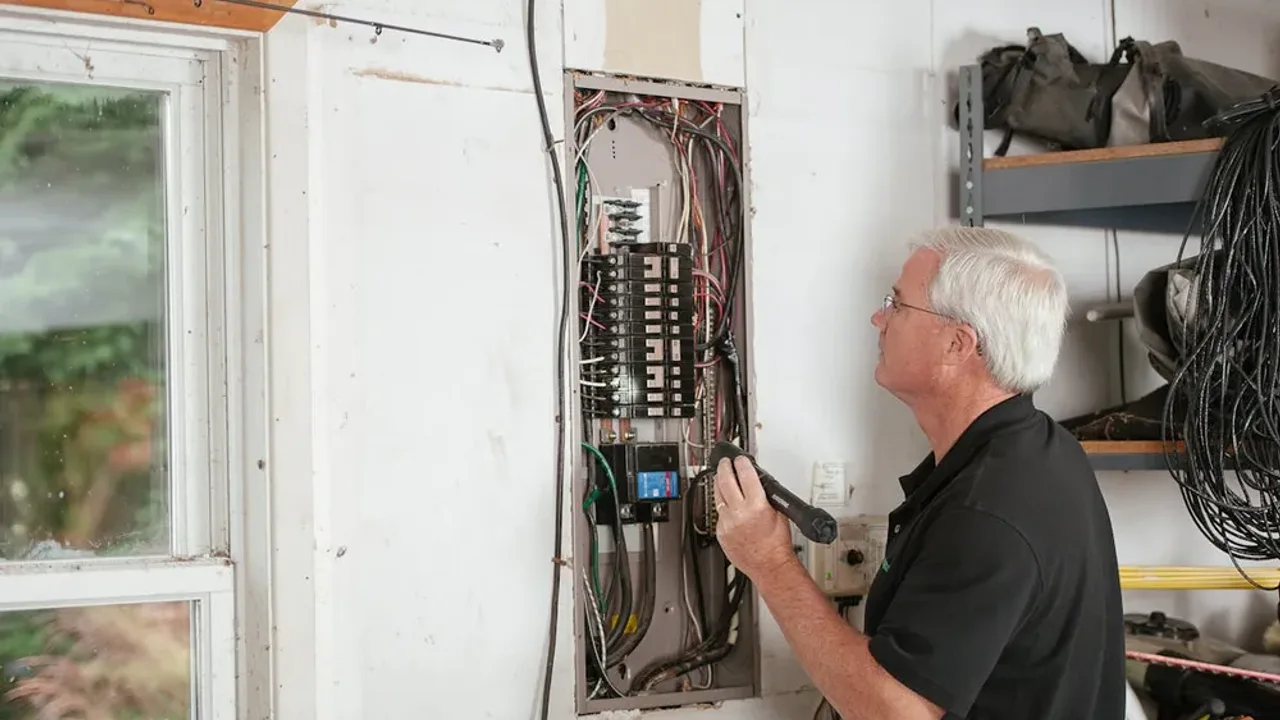
If your New Braunfels or Seguin home was built between the 1950s and the 1980s, there's a real chance it has a Federal Pacific (Stab-Lok) or Zinsco electrical panel - designs whose breakers can fail to trip during an overload, leaving the circuit unprotected. They aren't illegal to keep, but independent testing, a peer-reviewed study, and a growing number of insurers all point the same direction: find out what you have, and plan to replace it.
Here is the honest, sourced version - what's actually true, what's myth, how to tell if you have one of these panels in 30 seconds, and what it costs to fix. No scare tactics, because the facts are serious enough on their own.
Are these panels actually dangerous?
Yes - Federal Pacific Stab-Lok panels are widely regarded as a fire hazard, for one specific reason: their breakers can fail to trip during an overload or short circuit. A breaker has one job - when too much current flows, it cuts the power before the wire overheats. When it doesn't, the wire keeps heating behind your wall with nothing to stop it.
This isn't a fringe theory. Independent testing to the UL safety standard found Stab-Lok breakers failing at rates far beyond any normal breaker, and - the strongest documented fact - a New Jersey court ruled in 2002 that the manufacturer "knowingly and purposefully distributed circuit breakers which were not tested to meet UL standards as indicated on their label." We'll get to the exact numbers, and the myths, below.
How the failure actually happens
The danger isn't that the panel sparks or smokes where you can see it. It's that it quietly does nothing when it's supposed to act - and there's no warning behind a closed metal door.
One detail almost no one mentions, and it matters: the failures are worst on the double-pole 240-volt breakers - the big ones feeding your air conditioner, electric dryer, and range. Those are the high-current circuits where a breaker that won't trip is most dangerous. Zinsco panels add their own twist: a breaker can melt and weld itself to the aluminum bus, so the handle flips to "off" but power keeps flowing.
How to tell if you have one
You can usually identify these in under a minute. Open the panel door (just the outer door - leave the inner cover to an electrician) and look for the name and the breaker style.
One caution: not every "Sylvania" panel is a Zinsco. Some Sylvania panels use a completely different, unaffected design. The names to worry about are Zinsco, GTE-Sylvania, and Magnetrip specifically.
The verified facts - and the myths to ignore
Because this is a safety topic, here's exactly what's documented and what gets overstated online:
- The testing is real. Independent evaluation to the UL 489 standard found Stab-Lok double-pole breakers failing to trip at rates reported as high as roughly two-thirds, and a peer-reviewed 2012 study in the IEEE journal put the modeled added fire risk at an estimated 2,800 fires a year. Treat that fire number as an estimate from a model, not a counted body of incidents - but the underlying failure-to-trip finding is well supported.
- The UL-label ruling is the strongest fact. A New Jersey court found the company sold breakers not tested to meet the UL standard printed on their label. That's documented, not folklore.
- The CPSC myth. You'll read that the Consumer Product Safety Commission "investigated and cleared" these panels. It did not. The CPSC closed its investigation in 1983 because it would cost millions to finish and it was out of budget - and it explicitly closed without making a determination that the breakers were safe. "We ran out of money" is not "we found no problem."
- Zinsco's numbers are softer. The widely repeated "29% of Zinsco breakers won't trip" figure has weaker sourcing than the Federal Pacific data, so take it as "independent testing has reported high failure rates," not gospel.
So: not illegal, not recalled, but a documented defect that the manufacturer was found to have mislabeled. That's the honest middle ground - and it's plenty.
"It works fine, though."
This is the part we feel strongly about, because we hear it on nearly every one of these calls. "It works fine" is not a panel safety assessment. One of these panels can power your home flawlessly for years - right up until the one moment it's supposed to trip and doesn't. The whole defect is that it works fine until the exact instant it needs to protect you. The absence of a problem today is not evidence there's no problem.
Here's what it looks like in practice. There's a lot of housing in Seguin and New Braunfels built from the 1950s through the 1970s, and a real share of it still has the original Federal Pacific panel. Justin finds one or two a year - usually during an inspection before a home sale, or on a service call for something else entirely. They look fine. They test fine at a glance. He points it out, explains what it is and why it matters, gives a flat-rate quote to replace it, and doesn't push. Most people replace it. A few don't. He makes sure they understand exactly what they're choosing either way.
What it means for your insurance
This is the reason a lot of homeowners deal with it now rather than later, and it catches people off guard. Two separate things are true:
- Your insurance won't pay to replace it. A panel swap is considered maintenance, not a sudden loss, so it's not a covered claim.
- And increasingly, your insurer won't cover the home until it's gone. On older homes, carriers run a four-point inspection (roof, plumbing, HVAC, electrical). When an FPE or Zinsco panel turns up, it's common to get a notice - often 30 to 90 days - to replace it or lose the policy, or to be declined a new policy outright.
In Comal and Guadalupe County, where the housing skews older, this comes up a lot - usually at the worst time, right in the middle of buying or selling a home.
Are all of them bad? And can't I just swap the breakers?
Two honest answers. First, these are treated as a defective product line, not a handful of bad units - so "maybe mine's one of the good ones" isn't a safe bet. Second, no, you can't just replace the breakers: the replacement breakers sold for these panels carry the same design flaw, and on a Zinsco the bus connection itself is part of the problem. The real fix is a new panel - which also brings the whole thing up to current code.
What to do, and what it honestly costs
Don't panic, but don't ignore it. The order of operations:
- Confirm what you have. A licensed electrician evaluates the panel and tells you exactly what's there. Our panel evaluation is $100 to $150, with a written report.
- Replace the panel (not the breakers) with a modern, code-compliant load center. A full replacement is typically a few thousand dollars depending on the amperage, any service upgrade, and code add-ons like an exterior disconnect and arc-fault protection. We quote it flat, in writing, before any work starts.
- We pull the permit and pass inspection. It's done right and on the record - which is also what your insurer wants to see. Licensed TACLB127071E.
If your breaker has also been tripping or doing something odd, that's a separate signal worth reading - see why a breaker keeps tripping. And being both a licensed electrician and HVAC shop, we can handle the panel and the AC or dryer circuits feeding it in one visit. See our New Braunfels electrical services or request a quote.
Federal Pacific (Stab-Lok) and Zinsco panels can fail to trip - a documented defect, not a myth, though the CPSC never actually ruled them safe. Look for the red-striped breakers or color-coded Zinsco handles in a home built 1950s-1980s. It's not an emergency evacuation, but it's a real fire risk and a growing insurance problem, and the fix is a new panel, not new breakers.
Not sure what's behind your panel door in New Braunfels, Seguin, or anywhere nearby? We'll confirm it and give you the honest answer. Call (830) 587-5790 or request a quote online.