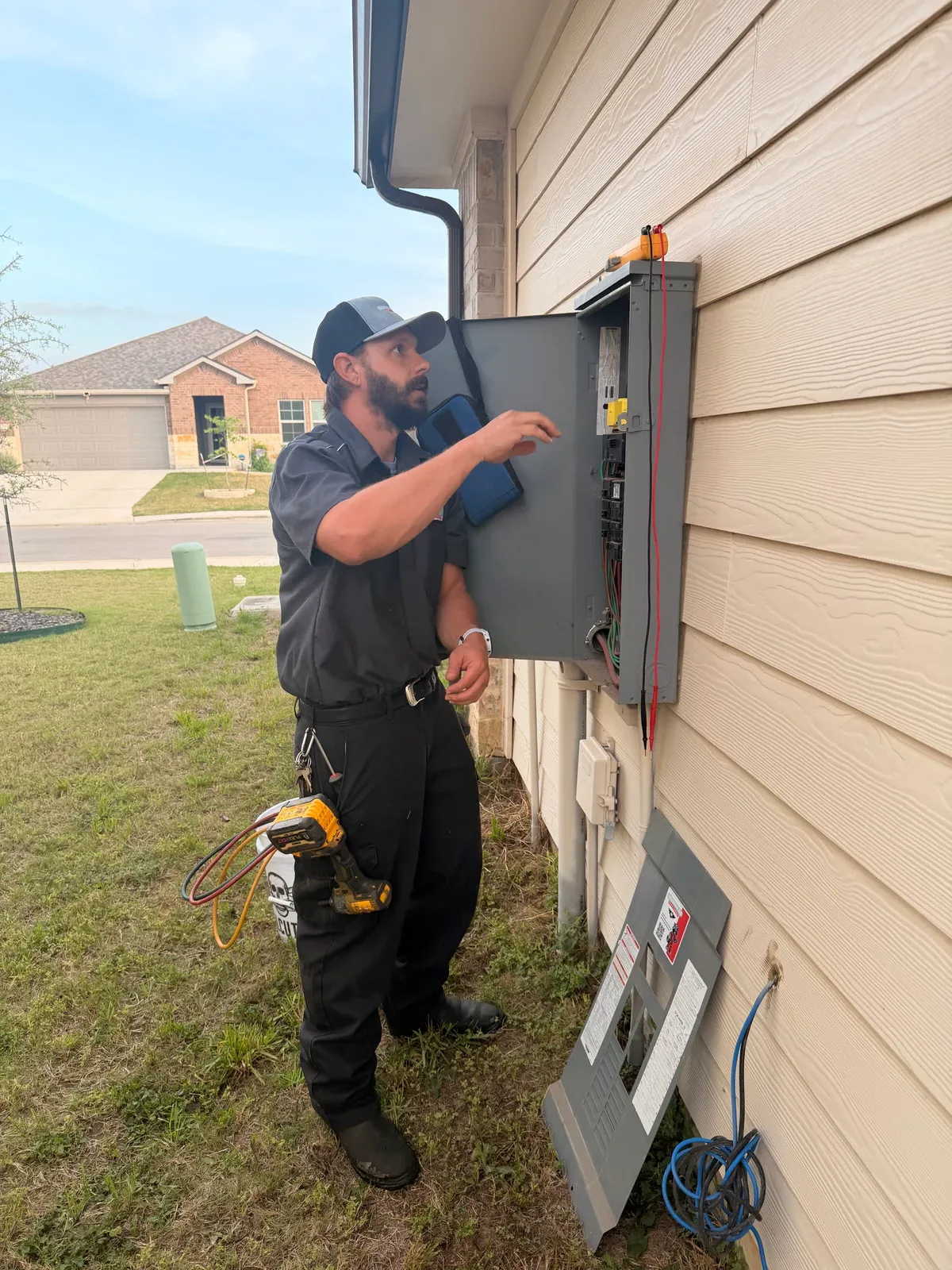
A circuit breaker that keeps tripping is usually doing exactly what it was built to do - cutting power before a wire overheats. The three most common causes are an overloaded circuit (too many things on one line), a short circuit (a hot wire touching a neutral), or a ground fault (a hot wire meeting ground or water) - and less often a worn-out breaker or, in an older home, a panel that is no longer safe.
First, the good news - your breaker is doing its job
A breaker that trips is not broken. It is a safety switch cutting power before a circuit overheats, and the trip is a symptom telling you something is wrong downstream. The job is to find what - not to keep flipping it back on and hoping. Here are the three usual causes:
- Overloaded circuit - too many devices pulling power on one line, past what the wire is rated for. The most common cause by a wide margin. DIY check
- Short circuit - a hot wire touching a neutral, which dumps a surge of current and trips instantly. Signs: a pop, a burning smell, scorch marks, a trip the moment you reset. Call a pro
- Ground fault - a hot wire meeting a ground wire, grounded metal, or water. Common in kitchens, baths, garages, and outdoors. Pro
The reset-once rule - and exactly when to stop
Reset a tripped breaker once. If it holds, you are probably fine. If it trips again immediately - or you smell burning, see scorch marks, or the breaker is hot to the touch - stop. Leave it off and call a licensed electrician. Flipping a breaker back on against a real fault is how you get an arc flash or an electrical fire, and it is never worth it. The breaker tripping is the cheap warning; ignoring it is the expensive one.
How to find what is tripping it
For a breaker you suspect is just overloaded, this finds the culprit:
- Unplug everything on the circuit and reset the breaker once.
- If it holds, plug devices back in one at a time, waiting between each.
- The one that trips it is your answer - usually a high-draw appliance like a space heater, hair dryer, microwave, or portable AC sharing a circuit it should not.
- Move that device to another circuit. If the breaker trips again with nothing plugged in, you are past the DIY line - that points to a short or a wiring fault.
The dangerous ones - when it is not a simple overload
Arc faults and AFCI breakers
Damaged or loose wiring can spark - arc - and an AFCI breaker is built to catch that pattern and trip before it starts a fire. Worth knowing the difference: an AFCI stops fires, a GFCI stops shocks. If an AFCI keeps tripping with nothing suspect plugged in, the problem is likely wiring inside the wall, and that is a licensed-electrician job.
A worn-out breaker
Breakers wear out after fifteen or twenty years and start tripping too easily, or feel hot, or will not reset. If a breaker keeps tripping even after you have removed the load, the breaker itself may be the problem - which is panel work, not a DIY swap.
Federal Pacific and Zinsco panels - the breaker that will not trip
Here is the one we feel strongly about. Federal Pacific Stab-Lok and Zinsco panels - common in homes built from the 1950s through the 1980s, and there are plenty in Comal and Guadalupe County - are documented to fail to trip under overload. Think about what that means: a nuisance trip is annoying, but the real danger in one of these panels is the breaker that is supposed to trip during an overload and does not. Instead of cutting power, it lets the wire keep heating. That is how fires start inside walls.
Justin finds one or two of these a year - usually during an inspection before a home sale, or on a service call for something else. He explains what it is, gives a flat-rate quote to replace it, and does not push. Most people replace it; a few do not; he makes sure they understand what they are choosing either way. Insurance carriers are increasingly refusing coverage on homes with these panels, which tends to make the decision for people. "It works fine" is not a panel safety assessment - one of these can test functional on a Tuesday and start an arc on a Wednesday.
Aluminum wiring in older homes
Homes built roughly 1965 to 1973 often have aluminum branch wiring. It expands and contracts more than copper, so connections loosen over time, and loose connections arc and heat up. The CPSC found homes with this wiring are about 55 times more likely to develop fire conditions at the connections. If your breaker trips and you have wiring of that vintage, it is worth an assessment.
When the tripping breaker is really your panel - and your AC
Sometimes the thing tripping is the thing that is broken - a worn breaker or an unsafe panel. And sometimes the breaker only trips when the air conditioner kicks on, which is its own clue. This is where being both a licensed electrician and an HVAC shop under one roof actually matters: we can chase a fault from the condenser or the thermostat all the way back to the panel, instead of telling you to call a second company and book a second visit. A breaker that trips every time the AC starts is a conversation between the two trades, and we speak both.
What this kind of electrical work costs
Every price is flat-rate and in writing before we start. A few common ones, from our published pricing:
| Service | What's included | Typical range |
|---|---|---|
| FPE / Zinsco panel evaluation | Safety report + replacement quote | $100-$150 |
| Aluminum wiring assessment | Full extent mapping + remediation quote | $150-$250 |
| GFCI outlet installation | Test, install, code documentation | $75-$150 per location |
| AFCI breaker upgrade | Replace, test, document | $75-$125 per circuit |
A full panel replacement is quoted after a load calculation. We pull permits and pass inspection - licensed TACLB127071E.
When to call a licensed electrician
- The breaker trips again the instant you reset it, or with nothing plugged in
- Any burning smell, scorch marks, buzzing, or a breaker hot to the touch
- You have a Federal Pacific, Stab-Lok, or Zinsco panel
- An AFCI or GFCI keeps tripping with no obvious cause
- The breaker trips only when a specific appliance - or the AC - turns on
Breaker you cannot figure out in New Braunfels, Seguin, or anywhere nearby? We will trace it properly and quote the fix in writing. Call (830) 587-5790 or see our electrical services.