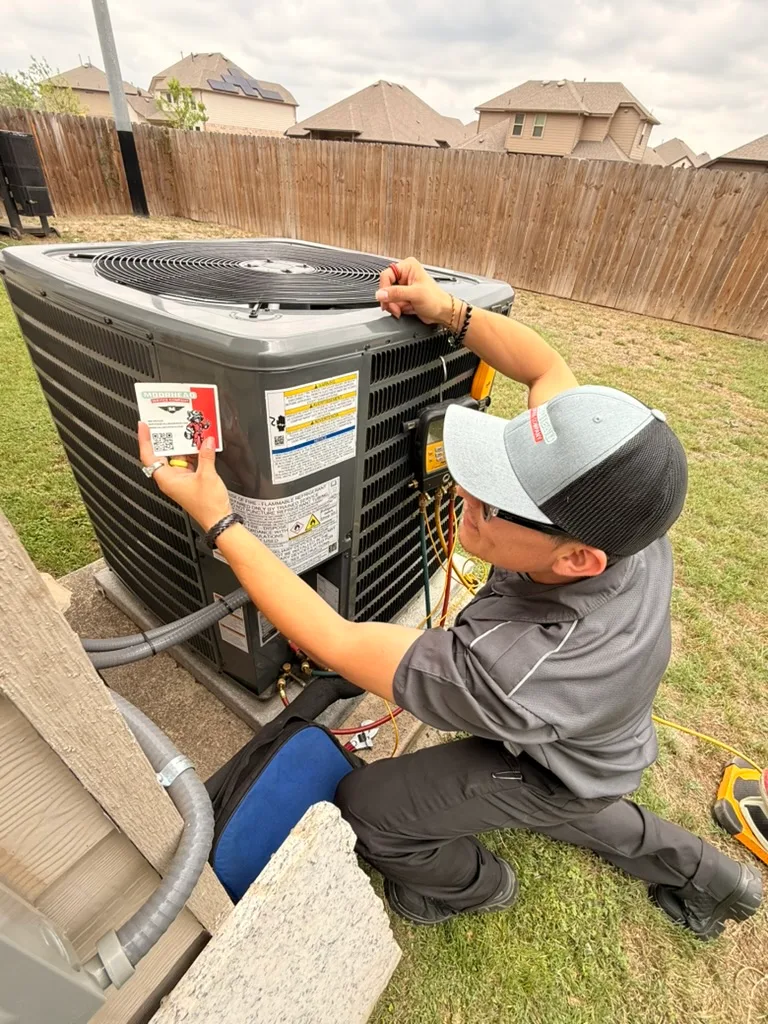
Central air conditioning is usually the right call for cooling a whole house that already has ductwork, because one system handles every room through the ducts you already have. A ductless mini-split wins for a specific problem: a room that never cools, a garage or shop, an addition, an upstairs the main system cannot keep up with, or a house with no ducts at all. Plenty of Texas homes end up with both: central AC for the house, and a mini-split for the one room it cannot reach.
Both of these cool a Texas house well. They just solve different problems, and the expensive mistake is buying the wrong one for the job in front of you. Here is the honest breakdown: how each works, when each one wins, and what they actually cost.
The short version, side by side
| Central AC | Ductless Mini-Split | |
|---|---|---|
| Needs ducts? | Yes | No |
| Best for | Cooling a whole ducted house | A room, garage, addition, or no-duct home |
| Zoning | One zone unless you add dampers | Each head is its own zone |
| Efficiency | High, loses some air to duct leaks | Very high, no duct loss |
| Install | Uses existing ducts | Mounts a head and a small line set |
| Look | Hidden in vents | A visible head on the wall |
| Installed cost | $8,570 to $12,320 | $5,570 to $9,580 (one zone) |
How central AC works, and when it wins
Central air conditioning cools the whole house from one system and pushes the cold air through a network of ducts to every room. If your home already has decent ductwork, this is almost always the right answer for whole-house cooling. It is out of sight, it runs off one thermostat, and the equipment is proven. When your existing central system is simply old or undersized, replacing it with a right-sized central unit is usually the straightforward, cost-effective move.
The ducts you cannot see are doing most of the work, which is exactly why nobody thinks about them until one room stops cooling.
How a mini-split works, and when it wins
A ductless mini-split skips the ducts entirely. A small outdoor unit connects to one or more indoor heads mounted on the wall, and each head cools its own space directly. No ductwork, minimal construction, and each head is its own zone with its own remote. That makes it the right tool for a specific list of Texas problems:
- A room that never cools. The bonus room, the office over the garage, the sunroom the central system was never sized to reach.
- A garage or workshop. If you want the garage gym usable in a Texas August, a mini-split is the clean way to do it without tying into the house system.
- An addition. Extending ductwork into a new room is expensive and often underperforms. A mini-split conditions the new space without touching the existing system.
- An upstairs that will not keep up. Two-story homes stack heat upstairs. A mini-split on the worst room, or a small multi-zone, fixes it without oversizing the whole house.
- A home with no ducts at all. Older houses, cabins out in the county. Ductless gives you real cooling without tearing the place apart to run ducts.
And honestly, this is where we part ways with a lot of companies. When the upstairs will not cool, the lazy fix is to sell you a bigger condenser and hope. We would rather run the numbers and put a mini-split or a zoning fix exactly where the problem is. The right tool beats the big tool, every time.
Efficiency and zoning
Two places a mini-split quietly pulls ahead. First, no ducts means no duct loss, and a typical home leaks 20 to 30 percent of its conditioned air through the ductwork before it ever reaches a vent (that is an ENERGY STAR figure, and yes, you are paying to cool the attic). A ductless system delivers its cooling straight into the room. Second, zoning: every head runs independently, so you cool the rooms you are using and leave the guest room alone. Central AC cools the whole house to one setpoint unless you add zoning dampers. For a house you actually live in all of, central is efficient and simple. For a house where half the rooms sit empty, per-room control saves real money.
What each costs, installed
We publish real numbers, so here they are, all-in installed (equipment, labor, permit, haul-away):
- A ductless mini-split for a single room or zone runs $5,570 to $9,580.
- A multi-zone ductless system, two to five heads for a whole home, runs $8,570 to $15,525.
- A new central AC-only split, keeping your gas furnace, runs $8,570 to $12,320.
Every price is flat-rate, in writing, and set after a load calculation, not guessed off the old unit's label. You can see the full lineup on our HVAC systems page.
The combo most homes land on
Here is what actually happens in a lot of Central Texas homes: central AC for the house, plus a single mini-split for the one space it cannot reach. You are not replacing a working central system to fix one hot room, and you are not asking a mini-split to cool the whole house when the ducts are already there. Each does the job it is good at. That is usually the cheapest outcome, not the biggest sale.
So which should you get?
Lean central AC if you are cooling a whole house that already has decent ductwork and you want one simple system. Lean a ductless mini-split for a specific problem area, an addition, a garage, an upstairs that will not cool, or a home with no ducts. And do the combo when you have a good central system and one stubborn room, which is the most common situation of all.
Central AC is the right call for cooling a whole house that already has ducts. A ductless mini-split wins for a hot room, a garage, an addition, a stubborn upstairs, or a home with no ducts, and it is more efficient because it skips duct loss and zones room by room. Many homes do best with both. Whichever you choose, size it with a real load calculation, not a guess.
Trying to cool a stubborn room or a whole house in New Braunfels, Seguin, or the Hill Country? We will run the load calculation and tell you honestly whether it is central, ductless, or both. Call (830) 587-5790 or get a quote online. If you are also weighing the heat side, our heat pump vs gas furnace guide covers that decision, and a lot of what drives a summer bill is the same duct-and-efficiency story from why your electric bill runs high.