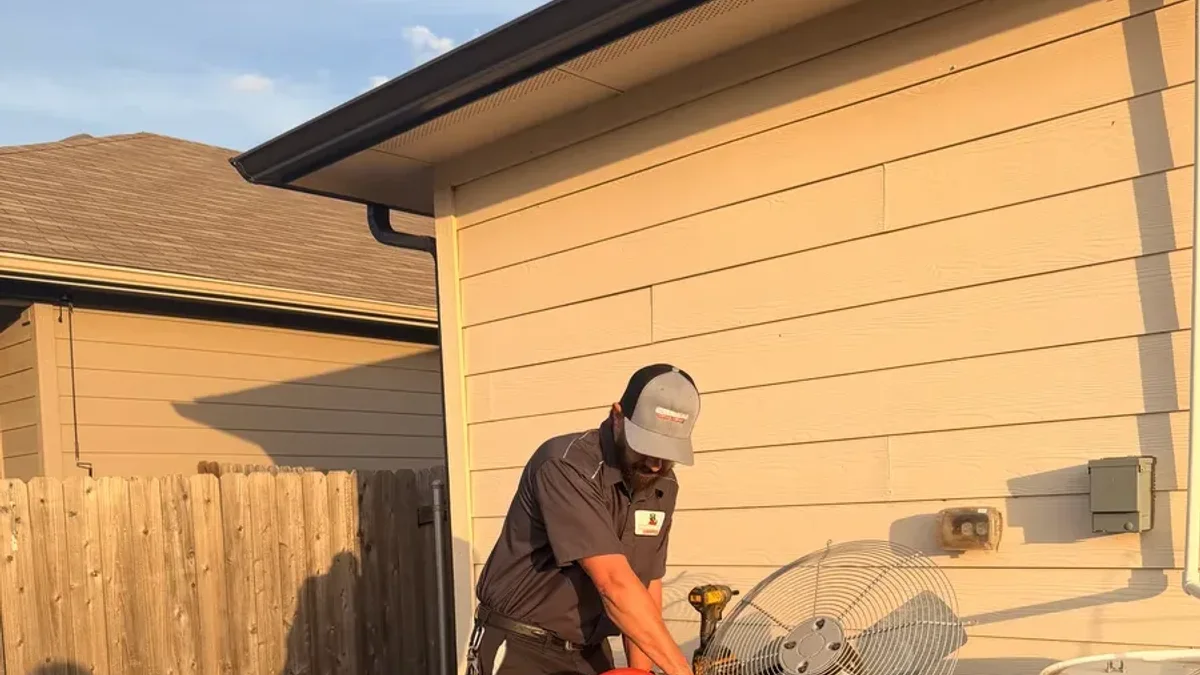
A well-maintained central AC in Texas lasts about 15 to 20 years. Skip the yearly maintenance and the heat down here cuts that closer to 10 to 12, because our cooling season runs nearly twice as long as most of the country and your system almost never gets a break.
So the real answer is not a single number, it is a range, and where your system lands in that range is mostly up to how it was installed and whether anyone ever services it. Here is what actually decides it, how to find out how old yours is, and how to tell when it is genuinely near the end versus just having a bad day.
The honest answer, and the Texas asterisk
Nationally, people quote 15 to 20 years for a central AC. That number assumes a climate that gives the system a rest. Ours does not. From roughly April to October the compressor is running hard, and a unit in New Braunfels logs far more run hours per year than the same unit in, say, Ohio. More run hours means more wear, so the honest Texas range looks like this.
That gap, five to eight extra years, is not a rounding error. On a system that costs several thousand dollars to replace, those years are real money.
How old is your AC right now?
You do not have to guess. Every outdoor unit has a metal data plate, usually on the side, with a model and serial number. In most brands the manufacture date is encoded in the serial number, often the first four digits as a week and year, or a year hidden in the middle. If you would rather not decode it, any tech can read it off in seconds, and it is the first thing we check when someone asks whether it is time.
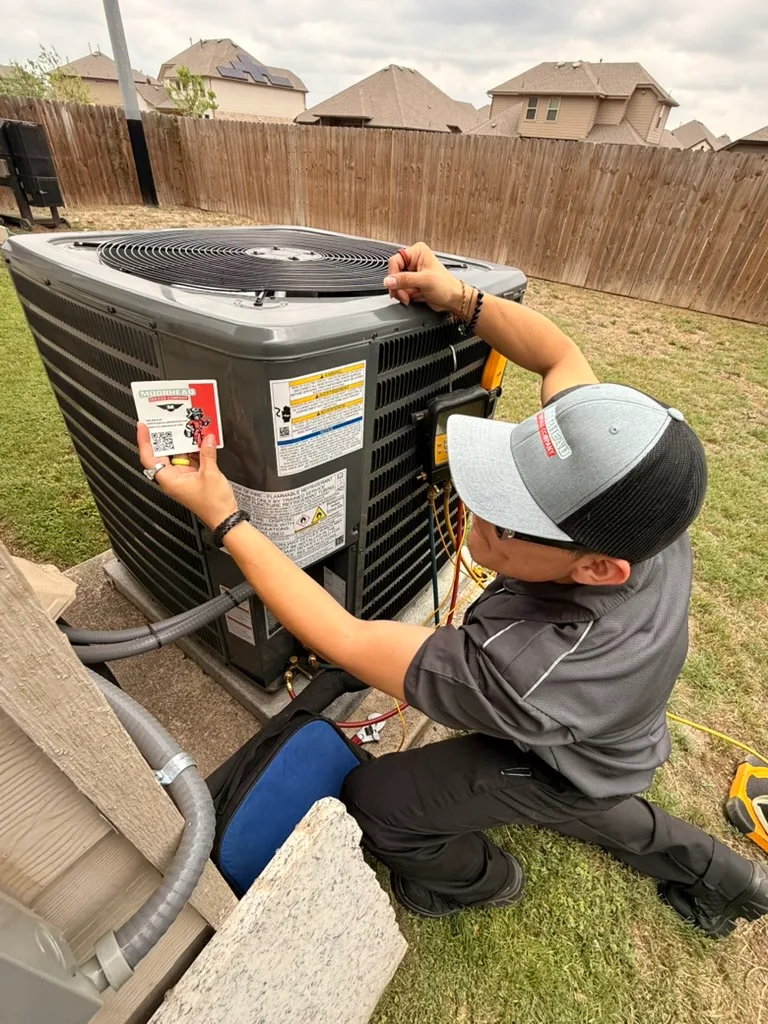
Your "AC" is really three machines
When people ask how long an AC lasts, they picture the box humming away outside. But a central system is three parts, and they do not wear out at the same rate. Knowing which one is tired tells you whether you are looking at a repair or a replacement.
- The condenser is the outdoor unit, and it takes the full Texas sun and the hardest work. It is usually first to go, and its data plate is the age most people mean.
- The evaporator coil sits inside, in the air handler or above the furnace. Coils develop slow refrigerant leaks as they age, and a leaking coil on an older system is one of the classic repair-or-replace moments.
- The air handler or furnace moves the air. A gas furnace often outlives the AC it shares a closet with, which is why a common job down here is a new AC bolted onto a furnace that still has good years left.
Nine times out of ten, when a system quits for good, it is the compressor inside that outdoor condenser that finally gives up. That is the expensive part, and on a unit past ten years it is usually the line between fixing and replacing.
What actually decides how long yours lasts
Age is the headline, but four things move a system up or down within that range a lot more than the year it was built.
The one that surprises people most is sizing. An oversized unit short-cycles, snapping on and off, which wears out parts faster and never pulls the humidity out of the air. A system installed right for the house runs longer, cheaper, and more comfortably. Not sure yours was sized correctly? A free load calculation settles it.
What kills an AC early out here
The heat and the run hours are the slow killers. A few things are the fast ones, and most of them you can do something about.
- Power surges. The ERCOT grid is its own animal, and the summer voltage swings and post-outage spikes are hard on the control board and the compressor. One big surge can take out a board that runs a few hundred dollars, or worse. A whole-home surge protector at the panel is cheap insurance on a several-thousand-dollar system.
- Hail and yard debris. A spring hailstorm flattens the condenser fins, and bent fins choke the airflow the unit needs to shed heat. Grass clippings packed into the coil do the slower version of the same thing.
- Topping off a leak instead of fixing it. Adding refrigerant to a leaking system year after year is not a repair, it is a subscription. It also runs the compressor low on charge the whole time, which shortens its life.
- Riding it flat-out through a heat wave. When it is 104 for two weeks and the house never quite cools, the system runs almost nonstop. That is exactly when a weak capacitor or a marginal compressor quits. Catching those parts in spring is the difference between a $200 fix and a bad afternoon in July.
Signs your AC is near the end
One of these alone is not a death sentence. Two or three together, on a system past ten years, usually is.
- It is 10 or more years old and just needs a big repair. The math tips toward replacement when the repair runs past half the cost of a new unit. Weigh it
- Your electric bill keeps climbing with no change in how you use it. An aging system works harder for the same cooling, and that shows up on your AEP bill. Check
- Repairs are stacking up. One repair in ten years is normal. Three in two years is the system telling you something. Pro
- It runs on R-22 refrigerant. R-22 was phased out in 2020, and the price to recharge a leaking R-22 system is high and climbing. A major R-22 repair is often the moment to replace. Pro
- Rooms never quite get comfortable, and the house feels sticky even when the AC is running. An old, undersized, or worn system loses the fight with a Texas August. Check
- It gets loud. New grinding, banging, or a compressor that hard-starts with a clunk are late-life sounds. Pro
When to start planning, before it forces your hand
The worst time to buy an AC is the afternoon it dies in July. You are hot, you are rushed, and you take whatever quote you can get that day. The best time is the season before, when you can compare options and are not negotiating from a puddle of sweat.
Here is the simple rule we give people. Once your system passes ten years, start paying attention. If it is still running well and maintained at twelve or fifteen, keep it and enjoy not spending the money. But the first time a well-worn system past twelve needs a repair north of a thousand dollars, that is your cue to price a replacement instead of writing the check. Planning it on your terms beats space heaters and cold showers while you wait on a crew during the busiest week of the year.
The seven-year-old system that was not old
Here is the myth worth killing: that a number on the data plate decides the whole thing. It does not.
We get a call a few times a year, usually from Schertz or Cibolo or Canyon Lake, from someone another company told to replace their whole system. New unit, new air handler, eight to twelve thousand dollars, and the tech "strongly recommended" acting now. We go out, and half the time the system is nine years old with a failed capacitor and a dirty coil. A couple hundred dollars of honest repair and it has three to five good summers left.
That is the whole point. Age tells you where to start looking, not what to do. The right answer comes from the condition, the refrigerant, and the repair history, and we will tell you the honest version even when it is the smaller invoice. The full framework is in our guide to the $5,000 rule for repair versus replace.
How to get to the top of that range
You cannot change the Texas heat, but you decide which bar your system lands on. It is not complicated:
- Get a real tune-up every year, ideally in spring before the season. It cleans the coil, checks the refrigerant and the electrical parts, and catches the small stuff early. Here is the honest case for whether a tune-up is worth it.
- Change the filter monthly in summer. A choked filter starves the system and is the cheapest way to shorten its life.
- Keep the outdoor unit clear. Two feet of breathing room, no grass clippings packed in the fins, some shade if you can manage it.
- Do not run it at 68 all summer. A sane setpoint means fewer run hours and less wear, and a smaller AEP bill on top.
The easiest way to never skip the yearly tune-up is to put it on autopilot. Our Comfort Club covers the annual visit, moves you to the front of the line when it gets busy, and knocks a bit off any repair you do need. That is the boring, cheap side of the ledger, and it is the side that decides which bar your system lands on.
What a new system costs when the time comes
When repair really has stopped making sense, here is the honest range so the number is not a surprise. Every price is flat-rate, all-in, and set by a free in-home load calculation, not a guess from the driveway.
| System type | What it is | Installed range |
|---|---|---|
| AC-only split | New AC, keep the gas furnace | $8,570-$12,320 |
| Heat pump split | All-electric heat and cool | $9,190-$14,135 |
| Gas furnace + AC | New AC plus an 80% gas furnace | $9,180-$12,865 |
| Ductless mini-split | One room, garage, or addition | $5,570-$9,580 |
Ranges run low to high by tonnage; installed, all-in (equipment, labor, permit, haul-away). A high-efficiency system also cuts cooling costs around 30 to 40 percent. For repair-side numbers, see what AC repair costs in New Braunfels.
Buying new in 2026? Ask about the refrigerant
This matters more this year than it used to. R-22 has been gone since 2020. But R-410A, the refrigerant in most systems installed over the last fifteen years, is now being phased down too, and new equipment is switching to the next generation, mainly R-454B.
What that means for you is simple. A brand-new system today is built for the current refrigerant, so parts and refrigerant stay easy to get for its whole life. A system still on R-410A is not obsolete, but as that refrigerant gets scarcer and pricier, a major refrigerant repair on an aging R-410A unit becomes one more reason to weigh replacing it. When we quote a new system, we tell you which refrigerant it uses and what that means down the road. No mystery, no scare tactics.
A maintained AC in Texas lasts 15 to 20 years; a neglected one, 10 to 12. Find the manufacture date on the outdoor unit's data plate, then judge by condition, not just age. Replace when it is past ten years and facing a repair worth more than half a new unit, or when a leaking R-22 system needs major work. And the single best thing you can do to reach the top of that range is a yearly tune-up and a fresh filter.
Not sure whether your system has years left or is running on borrowed time? We will read the data plate, check the condition, and tell you straight, in New Braunfels, Seguin, Canyon Lake, or anywhere nearby. Call (830) 587-5790 or request a quote online.