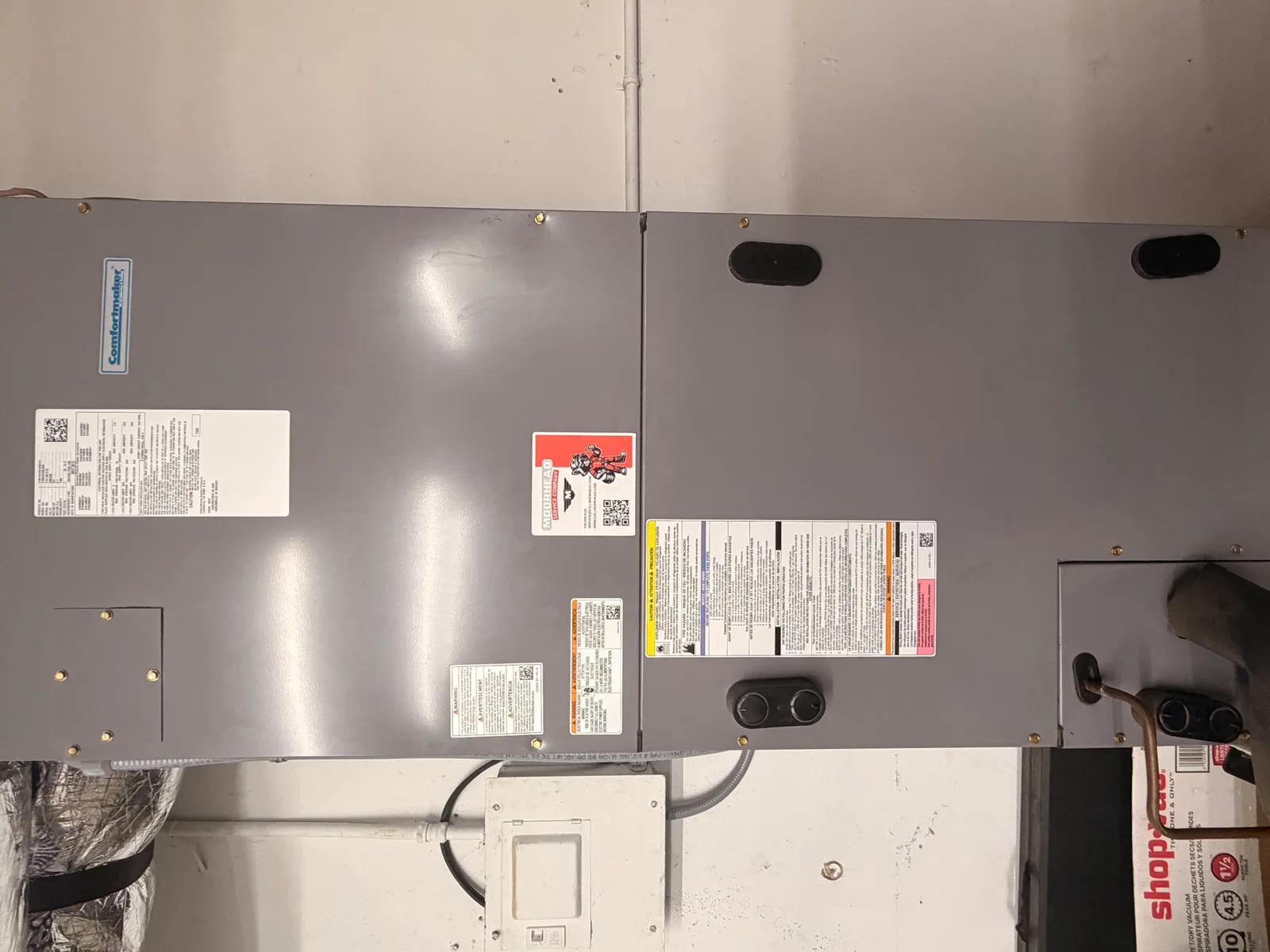
The $5,000 AC rule is a fast way to decide whether to repair or replace your air conditioner: multiply the unit's age in years by the repair cost, and if the answer tops $5,000, replacement usually makes more sense - under it, you repair. It is a decent starting point, not a verdict, and in 2026 there are a couple of things the formula leaves out that can flip the answer.
Below is the formula, the rules that compete with it, the two 2026 wrinkles most websites quietly skip, and the honest version a tech gives you standing in your driveway.
Age of the unit (years) × repair cost ($) = your number
Over $5,000, lean toward replacing. Under $5,000, lean toward repairing.
Run your numbers in the calculator →
The $5,000 rule, in one line
Multiply how old your system is by what the repair costs. If the result is over $5,000, replacement is probably the better money. If it is under, fix it and move on. Two quick examples:
- A 12-year-old system, $600 repair: 12 × $600 = $7,200. Over the line - start pricing a replacement.
- A 6-year-old system, same $600 repair: 6 × $600 = $3,600. Under the line - repair it.
It is a rule of thumb, not a law of physics. Nobody can tell you why the magic number is five thousand and not forty-eight hundred. It is close enough to be useful and round enough to remember, and that is the whole reason it caught on.
The other rules people use (and where they disagree)
The $5,000 rule is not the only shortcut floating around. Here are the other three you will run into - and the catch with all of them.
The 50% rule
If a repair costs more than half what a new system costs, replace. A $900 repair on a system you would replace for $9,000 is ten percent - fix it without thinking twice. A $3,500 repair on that same system is closer to forty percent, and now you are doing real arithmetic. This one carries the most weight once a system is past ten years old.
The repair-frequency rule
Count the repairs in the last three years. One is bad luck. Three is a pattern, and the pattern is telling you the system is wearing out from the inside. Down here, where a unit runs close to half the year, two service calls in a single summer sends the same message.
The age rule
Around ten years, start paying attention. Past fifteen, replacement is usually the conversation whether you want it or not - not because the unit is about to explode, but because everything on it got old at the same time.
When the rules disagree - which one to trust
Here is the problem nobody mentions: these rules can give opposite answers on the same unit. Take a 12-year-old system with a $1,500 repair and a $6,000 replacement. The $5,000 rule says 12 × $1,500 = $18,000 - replace, no contest. The 50% rule says $1,500 of $6,000 is twenty-five percent - repair, easily. Same unit, two rules, two opposite answers.
So which one wins? Honestly, none of them on their own. The $5,000 rule is a starting point, not a verdict. The real answer depends on what refrigerant the system runs on, how many times it has already failed, and what is actually broken - and a formula cannot see a single one of those things. A tech who actually put hands on the system can. Use the rules to know roughly where you stand, then let the diagnosis decide.
| Rule | The math | Says "replace" when… |
|---|---|---|
| $5,000 rule | age × repair cost | the result tops $5,000 |
| 50% rule | repair ÷ replacement cost | repair is over half the price of new |
| Repair-frequency | repairs in the last 3 years | 3 or more, or two in one summer |
| Age rule | age vs. lifespan | past ~15 years (watch from 10) |
What the formula leaves out - the 2026 wrinkles
Every repair-or-replace article online runs the same tidy math. Almost none of them mention the two things that actually moved the needle this year.
Old refrigerant is getting expensive
If your system runs on R-22, that refrigerant has not been made since 2020. What is left is reclaimed, and the price climbs every year - a recharge on an R-22 system can cost more than the leak repair itself. R-410A, the standard for the last fifteen years, is now being phased down on the same path: still perfectly legal to service, quietly getting pricier as supply tightens. So if an aging system has a refrigerant leak, that line item now weighs on the replace side harder than it did two years ago. We unpack this in our guide on an AC running but not cooling.
The new systems are not a drop-in
Equipment built today uses R-454B instead of R-410A. You cannot pour the new refrigerant into an old system - different pressures, different safety requirements. So "just convert it" is not a real option. It is repair the old one, or replace it with a new one. Those are the two doors.
The new one runs on a smaller power bill
An AC from 2010 might run at SEER 10 to 13. The minimum you can buy today is SEER2 15, and high-efficiency systems climb well past that. A high-efficiency replacement cuts cooling costs by roughly thirty to forty percent. That does not make replacement automatically right - but it means part of a new system pays for itself on the AEP bill every month, which the repair-versus-replace formula never counts.
Has it actually been looked after
A seven-year-old system that has been maintained is not old. A seven-year-old system nobody has touched is. The heat down here cycles units harder than almost anywhere in the country, and maintenance is the difference between catching a $200 capacitor in the spring and finding a dead compressor in July.
“Another company told me to replace it.” Read this before you sign.
This call comes in a few times a year. Someone in Schertz or Cibolo or Canyon Lake was told their system needs full replacement - new unit, new air handler, eight to twelve thousand dollars - and the tech "strongly recommended" doing it now.
Justin goes out. Half the time the system has a failed capacitor and dirty coils. Sometimes it is a refrigerant leak at a service-valve fitting that costs a couple hundred dollars to fix. The unit is nine years old and has plenty of life left. He repairs it, tells them it bought three to five more summers, and quotes the replacement for whenever they are actually ready - no pressure attached.

The reason that happens so often is that the most common failure on an AC is also one of the cheapest: a run capacitor, a part about the size of a soup can, $150 to $350 installed. That is a long way from a $9,000 system. The catch is that a dying capacitor makes the compressor work harder, and the compressor is the one part that genuinely costs four figures - so the cheap fix caught early is also what protects the expensive part. Let it slide, and the scary quote can turn real.
Either way, you get the number in writing before anyone touches anything. The written quote is the price.
Real numbers in the New Braunfels area
We are one of the only shops around here that publishes them, so here they are. Every price is flat-rate, written, and approved before we start.
| Repair | What's included | Typical range |
|---|---|---|
| Service call & diagnosis | Full diagnosis + written quote (waived when you book) | $79 |
| Run capacitor | Part on the truck, electrical test, run verification | $150-$350 |
| Refrigerant recharge | Includes leak check - we find the leak, not just top it off | $200-$600 |
| Contactor replacement | Electrical test + run verification | $175-$375 |
| Blower motor | OEM motor, airflow test | $400-$850 |
And the compressor - the big one - runs into four figures, which is exactly why it tips so many decisions toward replacement. On the replace side, installed and all-in:
| New system (installed) | What it is | Typical range |
|---|---|---|
| AC-only split | New AC, keep your gas furnace; 1.5-5 ton | $8,570-$12,320 |
| Heat pump - single stage | All-electric heat and cool; 1.5-5 ton | $9,190-$14,135 |
| Gas furnace + AC | New AC plus 80% gas furnace; 1.5-5 ton | $9,180-$12,865 |
Replacement prices are set by a free in-home load calculation, not a guess - equipment, labor, permit, and haul-away included.

Short term, repair is almost always the cheaper number. The rules and the 2026 costs are how you tell when the cheaper repair is actually the more expensive decision.
When replacing it really is the right call
We will tell you to replace it when replacing it is the honest answer. That usually looks like one of these:
- The system is 15 or more years old and everything on it is aging at once.
- It runs on R-22, or it is a leaky R-410A system staring down rising refrigerant costs.
- The compressor has failed - the one repair that routinely clears the $5,000 line on its own.
- Three or more repairs in three years, or two in a single summer.
- The repair clears the 50% line on a system already past half its life.
When that is the call, you get the same thing you get for a repair - a flat number in writing, and zero pressure. Get a free replacement quote and we will run the load calculation properly.
Run the $5,000 rule and the 50% rule to see roughly where you stand. If both point the same way, that is your answer. When they disagree, the deciding factors are the refrigerant, the age, and what actually broke - which is a diagnosis, not a formula. And if a quote jumped straight to full replacement without anyone naming the broken part, get a second set of eyes on it.
Repair or replace - New Braunfels, Seguin, Canyon Lake, or anywhere nearby - we will run the honest math with you and put it in writing. Call (830) 587-5790 or request a quote online.