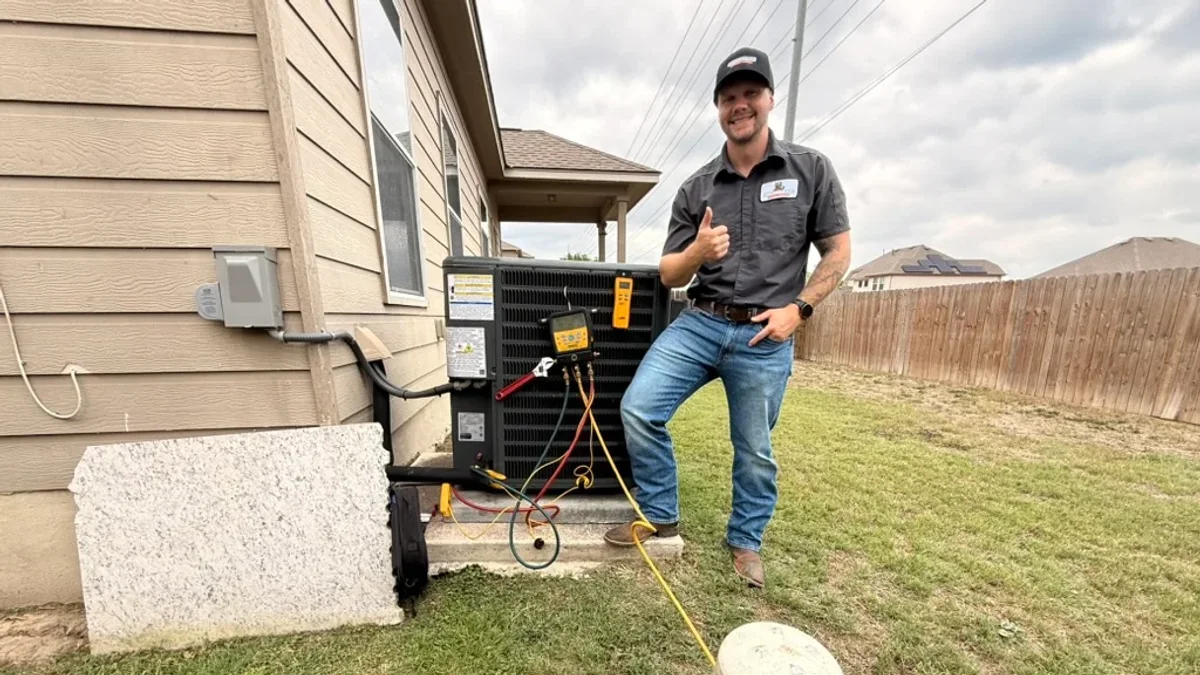
The single most common AC part to fail is the run capacitor - a soup-can-sized component that gives your compressor and fan motor the jolt they need to start and keep spinning. It's cheap, it fails in the heat almost every time, and the classic sign is an outdoor fan that won't turn or a compressor that just sits there and hums.
If your AC quit on a hot afternoon and the outdoor fan isn't spinning, a bad capacitor is the first thing we'd bet on before we ever leave the shop. Here's what the part does, how to tell when it's gone, what it costs to replace, and the one reason we'd rather you didn't poke at it yourself.
What a run capacitor actually does
Your compressor and fan motor are stubborn. They need a hard shove of electrical energy to break loose and start turning, and a steady hand to keep running smoothly after that. The capacitor is what stores and delivers that shove. Think of it as a small, fast battery whose only job is to hand the motors a jolt at exactly the right instant.
That's why a dead capacitor is so confusing. The unit still hums. It still has power. Everything sounds like it's trying. It just never actually turns, because the part that gives it the push is gone. It's running. It's just not doing its job. Which, honestly, same.
Why it's the part that fails first
Two reasons. First, capacitors are consumable by design - they slowly lose their ability to hold a charge every time they cycle, and a Texas AC cycles hard. Second, and this is the big one, they hate heat. The hotter it gets, the faster a capacitor breaks down, and the inside of an outdoor unit sitting in a South Texas July is about the least merciful place you could ask one to live.
So they fail in heat. Always in heat. Specifically on the hottest Friday of the hottest week, when the system's been running flat-out for three weeks straight and the whole family's home. It has a sense of timing, if not a sense of mercy.
I'll give you the honest version from the truck: the most common summer service call we run in Seguin isn't a refrigerant leak or a dead compressor. It's a capacitor. A part that costs about fifteen dollars wholesale, roughly the size and shape of a soup can, that decides to quit at 6pm when it's 104 out. I carry six of them in three different ratings on the truck for exactly this reason. (Not a complaint. Just context for why the truck rattles.) The repair takes about forty minutes and the house is cool before dinner.
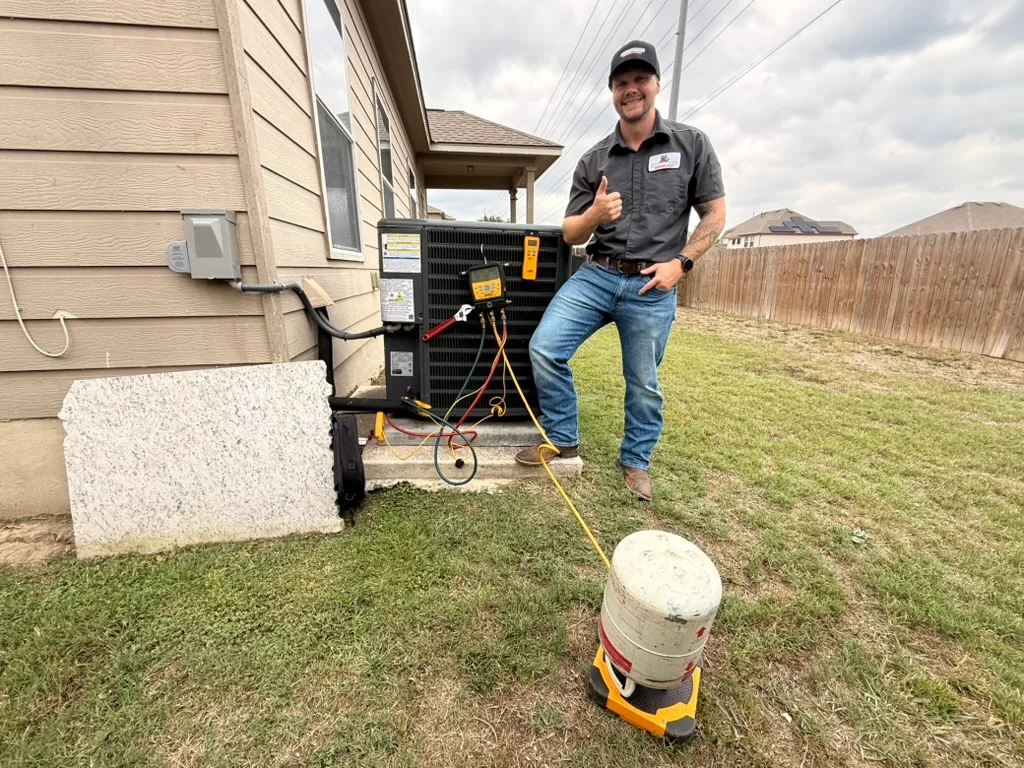
Signs your AC capacitor is bad
Run down this list. The more of these you've got, the more confident the bet.
- The outdoor fan won't spin - the unit hums but the top fan sits still. The single most common tell. Pro
- The compressor hums but won't start - you hear it straining, then it clicks off on its overload. Pro
- Warm air from the vents - the blower runs inside, but with the outdoor unit not cooling, you get room-temperature air. Check
- A clicking or humming from the outdoor unit - the sound of a motor trying to start against a dead capacitor. Pro
- The AC takes a few tries to start - a weak capacitor on its way out, starting hard before it fails completely. Pro
- A swollen or leaking capacitor - the top is domed instead of flat, or there's an oily residue or rust. A dead giveaway, if you can see it safely. Pro
- A higher electric bill - a weak capacitor makes the motors draw more current to do the same work. Check
That last physical sign is worth a picture, because it's the one thing a homeowner can sometimes spot from across the yard - a healthy capacitor is flat on top, and a dead one usually isn't.
Can I replace an AC capacitor myself?
Here's the one part where I'm going to talk you out of the YouTube video. Physically, swapping a capacitor is two wires and a bracket. The problem isn't the difficulty - it's that a capacitor stores a live electrical charge even after the power is off at the disconnect. Enough to hurt you badly, sometimes worse. It has to be discharged safely first, with the right tool, by someone who's done it.
On top of that, capacitors aren't one-size. Put the wrong microfarad (µF) or voltage rating in there and you'll burn out the new part, or worse, the compressor motor it's feeding - and the compressor is the one repair on the whole system where the honest answer is sometimes "it's time for a new unit." A fifteen-dollar guess that takes out a $2,000 part is a bad trade. This is the rare job where paying us the flat rate is genuinely the cheaper path. Here's the full list of what you safely can check yourself first - filter, thermostat, breaker - before it gets to the electrical side.
What a capacitor replacement costs
We're one of the only shops around here that publishes real numbers, so here they are. Every price is flat-rate, written, and approved before we touch anything - no "starting at," no surprise on the invoice.
| Repair | What's included | Typical range |
|---|---|---|
| Service call & diagnosis | Full diagnosis + written quote (waived when you book the repair) | $79 |
| Run capacitor replacement | Correct-rated part on the truck, electrical test, run verification | $150-$350 |
| Contactor replacement | Often paired with a capacitor on older units - electrical test included | $175-$375 |
Ranges drawn from current Moorhead flat-rate pricing; your exact price is quoted in writing on-site before any work begins. For the full repair price list, see what AC repair costs in New Braunfels.
Why the range on a fifteen-dollar part? Two things: the capacitor rating (a big dual-run capacitor for a five-ton unit costs more than a small single one), and whether it took the contactor with it. We tell you which before we start.
How to stop getting caught by it
You can't make a capacitor last forever - it's a wear part. But you can catch a weak one in the spring instead of meeting it at 6pm on the Fourth of July. A capacitor doesn't usually die all at once; it fades, reading lower and lower until it can't start the motor. A meter catches that months before you feel it.
That's the honest argument for a yearly tune-up, and I'll back it with the thing I actually believe: a seven-year-old system isn't old. A seven-year-old system that's never been serviced is. The $99 tune-up is the difference between a capacitor we swap in April on our schedule and a compressor we're arguing about replacing in July on yours. We test the capacitor as part of it, every time. Here's the honest breakdown of whether a tune-up is worth it - including when it isn't.
The most common AC part to fail is the run capacitor - a cheap, heat-sensitive part that gives your compressor and fan the jolt to start. The tell is an outdoor fan that won't spin or a compressor that hums and quits, and a healthy one is flat on top while a dead one bulges. Don't swap it yourself - it holds a live charge with the power off - but do get it tested at a yearly tune-up so it fails on your terms, not July's.
Fan not spinning in New Braunfels, Seguin, Canyon Lake, or anywhere nearby? Nine times out of ten it's the capacitor, and we carry them on the truck. Call (830) 587-5790 or request a quote online. We'll test it, tell you what it is, and quote it flat before we start. The joke we make while the house cools back down is on the house.