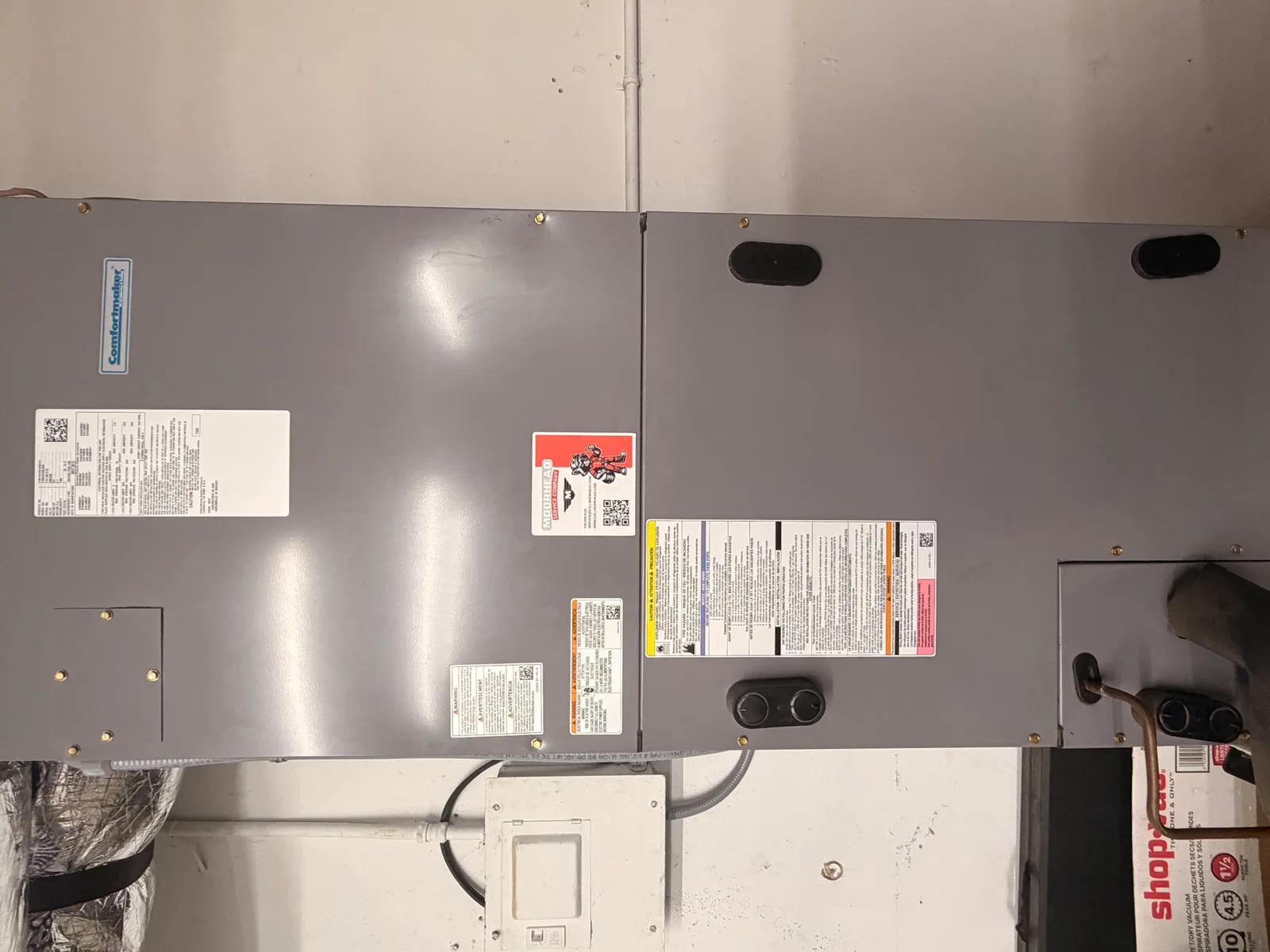
If your furnace will not turn on, start with the four things that cause it nine times out of ten: the thermostat, the breaker, the power switch on the side of the furnace, and the little safety switch behind the front panel. Most no-heat calls we run in a cold snap come down to one of those, and half of them you can check yourself in five minutes.
A furnace that will not come on is almost always one of a handful of things, and the good news is the cheapest, most common ones are the ones you can rule out from your own hallway. Here is the order to check, what each one looks like, and the point where it stops being a five-minute fix and becomes a call.
Start with these four, in this order
Before anything else, walk through these. Nine no-heat calls out of ten end right here, and there is no reason to pay for a service call to find a flipped switch.
- The thermostat. Set it to HEAT, then push the target a few degrees above the room temperature so it actually calls for heat. If the screen is blank or dim, change the batteries. It sounds too simple to be the answer. It is the answer more often than anything else on this list. Check
- The breaker. Find the furnace breaker in the panel. A tripped one sits halfway between on and off. Flip it fully off, then back on. If it holds, you are done. If it trips again right away, stop and call us, because something downstream is faulting and resetting it over and over is how small problems become fires. Careful
- The furnace power switch. There is a switch that looks exactly like a light switch, usually on or beside the furnace, sometimes at the top of the closet or basement stairs. It gets flipped off by accident constantly, by a guest, a cleaner, a kid, or you, reaching for a light. Make sure it is on. Check
- The front-panel door switch. The furnace has a removable front panel, and behind it a little plunger switch cuts all power unless the panel is seated right. Change a filter, leave the panel loose, and the furnace acts completely dead. Push it firmly until it clicks into place. Check
If one of those brought it back to life, you just saved yourself a service call, and you have my blessing to feel a little smug about it.
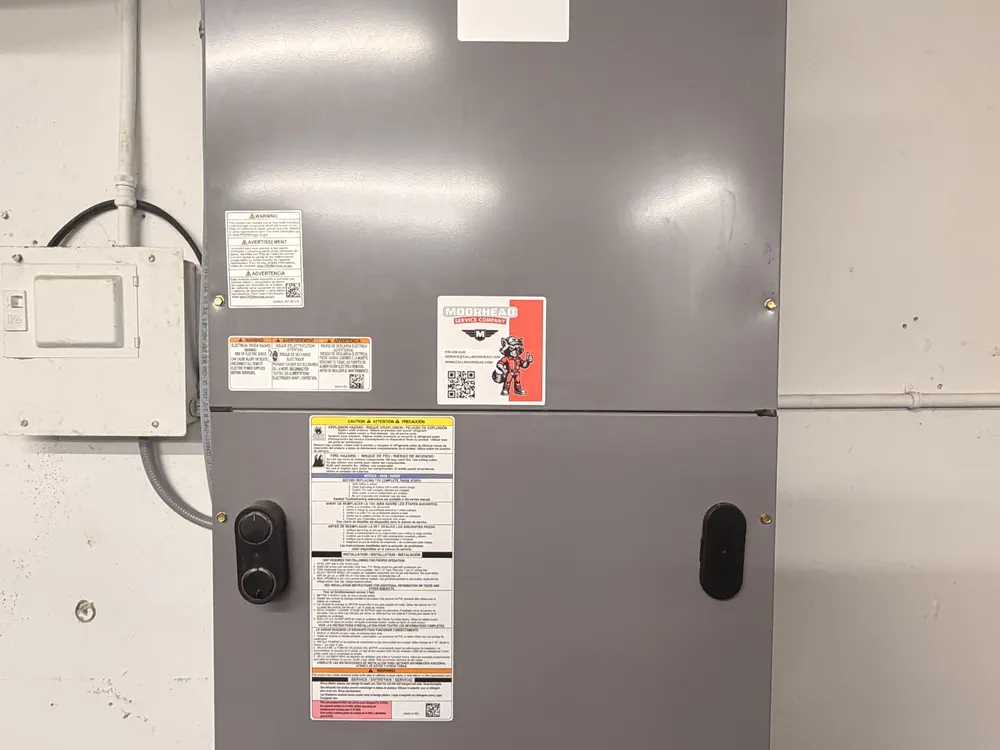
The one you never push past: a gas smell
Before you go any further, one hard rule. If you smell gas, that rotten-egg sulfur smell, stop troubleshooting. Do not flip switches, do not hunt for the problem. Leave the house, and from outside call your gas utility or call us. A furnace that will not light is a minor annoyance. A gas leak is not. We would always rather come out for nothing than have you chase a smell you should have walked away from.
If it is a gas furnace and the basics check out
Once power is confirmed and the thermostat is calling for heat, a modern gas furnace runs a startup sequence every time. Knowing the steps tells you roughly where it is stuck.
- The thermostat calls for heat and the control board wakes up.
- The inducer motor spins up to clear the flue. You will hear a small fan start.
- The ignitor glows or a spark clicks.
- The gas valve opens and the burners light.
- The flame sensor confirms the flame, and the main blower comes on a few seconds later to push warm air.
When a furnace will not fire, it is usually stuck at step three or four, and two parts cause most of it:
- A cracked or worn ignitor. The hot-surface ignitor is a small, brittle element that glows to light the gas. They wear out, and when one cracks the furnace goes through the motions but never lights. It is a common, not-too-expensive part.
- A dirty flame sensor. This is the classic. The furnace lights, runs a few seconds, then shuts the gas off and tries again, over and over. A thin film of grime on the flame sensor stops it from confirming the flame, so the board shuts things down as a safety. Cleaning or replacing it is a small job, and one of the more satisfying fixes we do, because the heat comes right back.
If the blower runs but only pushes cold air, that is a different problem with its own answers. We wrote those up separately in why your heater is blowing cold air.
What it usually is, by what you are seeing
Match the symptom to the likely cause. This is roughly how we think about it before we even open the panel.
| What you notice | Usually means | Yours to try? |
|---|---|---|
| Completely dead, no sound at all | Power: breaker, power switch, door switch, or thermostat | Yes, the four checks above |
| Clicks or hums, then nothing | Ignitor, control board, or a bad transformer | Call |
| Lights, runs a few seconds, shuts off, repeats | Dirty flame sensor, most of the time | Call |
| Blower runs but the air is cold | A different issue, see the cold-air guide | See link above |
| Breaker trips every time you reset it | An electrical fault, do not keep resetting | Call |
When to check it yourself, and when to call
Here is the honest line. The four checks up top, the thermostat, the breaker once, the power switch, and the door panel, are yours. They are safe, they are free, and they fix most no-heat calls.
Past that, you are into gas, high voltage, and safety switches that exist for a reason. A furnace is a controlled fire inside your house. When the fix involves the ignitor, the gas valve, the flame sensor, the control board, or a breaker that keeps tripping, that is where you call a licensed tech, not because of the license, but because that is where a wrong move stops being cheap. We read the sequence, find where it is stuck, and quote the repair in writing before we touch anything.
While you are down there, check the CO detector
Any time a gas furnace is acting up, take a look at your carbon monoxide detectors. CO is invisible and has no smell, and a furnace that is short-cycling, sooting, or burning a lazy yellow flame instead of a crisp blue one can be a sign of a combustion problem worth taking seriously. If you do not have a working CO detector near the bedrooms, that is a thirty-dollar fix you make today, not next week. We install hardwired, interconnected ones when we are already in the house, but a battery unit from the hardware store beats nothing by a mile.
What a furnace repair runs
So the number is not a surprise, here is the honest shape of a furnace repair. Every visit starts with a flat $79 service call that buys a real diagnosis and a written quote, and it comes off the bill when you book the repair. From there, most no-heat repairs are modest.
- A flame sensor clean or replace is usually the smallest of them.
- A hot-surface ignitor is a common wear part, priced flat once we confirm it.
- A control board or blower motor is the bigger end, and on an older furnace it is where we give you the honest repair-versus-replace read instead of just cashing the repair check.
Whatever it is, you get the flat-rate number in writing first. If the job turns out harder, that is our problem, not yours. For the full picture on when a furnace is worth repairing versus replacing, the same math we use for AC applies, and it is laid out in the $5,000 rule. The cheapest way to dodge a January no-heat call in the first place is a fall tune-up, which is exactly what our Comfort Club puts on autopilot.
A furnace that will not turn on is usually the thermostat, the breaker, the furnace power switch, or the front-panel door switch, and those four are safe to check yourself. If power is fine and it still will not fire, it is most often a worn ignitor or a dirty flame sensor, both small repairs. Never push past a gas smell, and never keep resetting a breaker that trips right back. Every repair starts with a flat $79 diagnosis, quoted in writing.
Cold house, dead furnace, and you have run out of switches to flip? We will find out why and tell you straight, in New Braunfels, Seguin, Canyon Lake, or anywhere nearby. Call (830) 587-5790 or request a quote online.